
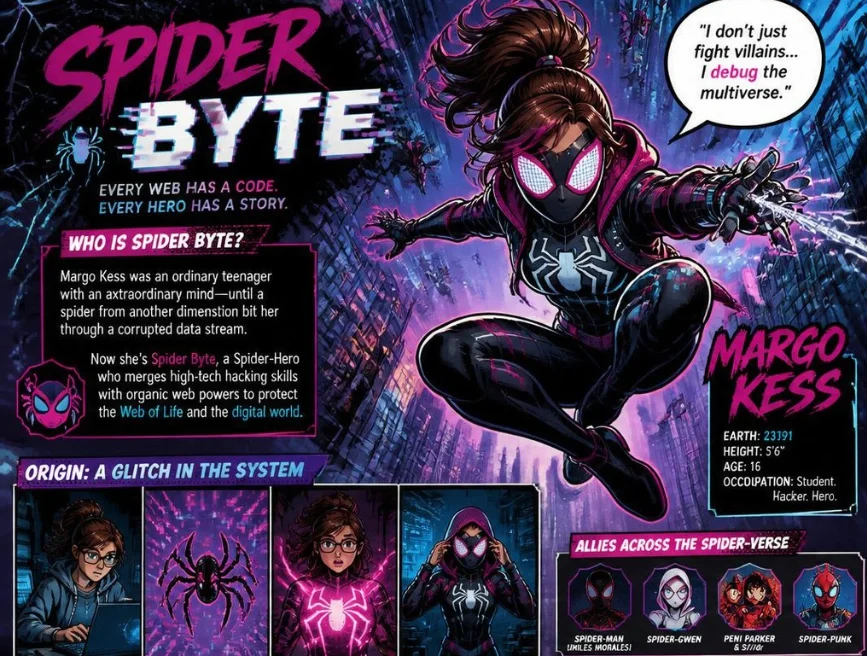
Spider Byte is the search-friendly spelling of Spider-Byte, the Marvel hero whose real name is Margo Kess. She comes from Earth-22191 and operates through a powerful virtual avatar. Movie audiences met her in Spider-Man: Across the Spider-Verse, where she becomes important during Miles Morales’ escape.
Margo isn’t another Peter Parker variant wearing a different costume. Her story connects Spider-Man ideas with virtual reality, programming, online identity, and digital crime. That combination gives her a distinctive place among the many heroes of the Spider-Verse.
| Quick fact | Details |
| Real name | Margo Kess |
| Superhero name | Spider-Byte |
| Home reality | Earth-22191 |
| First comic appearance | Vault of Spiders #1 |
| Comic debut | 2018 |
| Creators | Nilah Magruder and Alberto Jiménez Alburquerque |
| Main ability source | Virtual spider-themed technology |
| Movie appearance | Spider-Man: Across the Spider-Verse |
| Movie voice actor | Amandla Stenberg |
| Major affiliations | Spider-Army and Spider Society |
| Main specialty | Virtual technology and cybercrime |
Direct answer: Spider-Byte is Margo Kess, a Marvel character introduced in Vault of Spiders #1 in 2018. She comes from Earth-22191, where virtual reality shapes everyday life. Margo uses a spider-themed digital avatar with specialized technology. She later joins other Spider-People and appears in Spider-Man: Across the Spider-Verse.
Who Is Spider Byte?
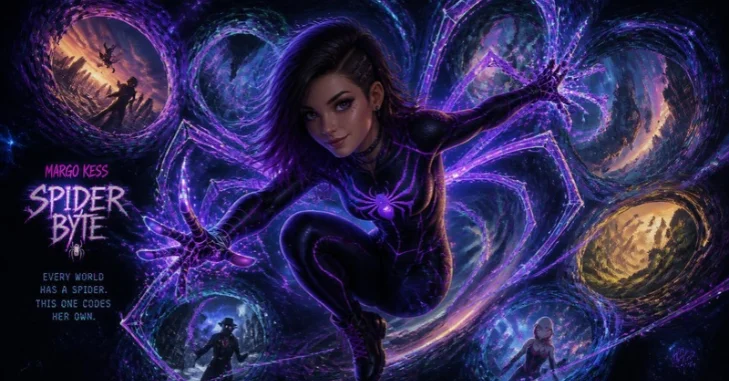
Spider Byte (Margo Kess) is a student and technologically gifted young hero from Earth-22191. People in her reality spend much of their lives interacting through virtual environments. Margo uses that digital society as the setting for her superhero activities.
Instead of receiving the familiar radioactive spider bite, she creates a spider-powered virtual identity. Her digital alter ego fights criminals operating online and protects other users. Readers interested in how online platforms affect identity can also explore Writinge’s guide to Messenger account availability.
Marvel introduced the character in Vault of Spiders #1 during the Spider-Geddon era. Writer Nilah Magruder and artist Alberto Jiménez Alburquerque created her original story. The issue reached comic stores in October 2018 with a December 2018 cover date.
Where Does Spider-Byte Come From?
Margo’s home is Earth-22191, an alternate reality built around extensive virtual interaction. Digital spaces matter far more there than they do in ordinary life. Her superhero identity naturally developed within that technology-focused culture.
She initially uses her abilities to confront cybercrime rather than traditional street crime. Her adventures include protecting digital users and stopping online criminals. That background separates her from Spider-People whose stories begin with physical mutations.
The distinction also explains the “Byte” in her superhero name. A byte is a familiar computing term, while “Spider” connects her with Marvel’s wider spider mythology. Her name therefore combines both sides of her character in a simple way.
What Powers Does Spider-Byte Have?
Spider-Byte’s abilities depend heavily on her virtual spider-armor and technical skill. Her equipment can increase her physical capabilities while she operates through the avatar. She also uses specialized tools that imitate familiar Spider-Man abilities.
Her gloves and boots feature magnetic grips that help her cling to surfaces. She also has photonic web-shooters that produce hard-light webs. These features create digital equivalents of wall-crawling and web-slinging abilities.
Margo’s intelligence remains equally important because she understands the systems around her. She isn’t defined only by strength or combat ability. Programming, problem-solving, and control of virtual technology make her useful when physical force cannot solve the problem.
Does Spider-Byte Have Real Spider Powers?
Her origin differs significantly from Peter Parker’s classic radioactive-spider story. Her abilities come primarily from virtual spider-armor, technology, and her digital avatar. Her powers therefore shouldn’t be understood as a simple copy of Peter’s biological abilities.
The distinction gets blurrier when Spider-Verse technology lets digital creations interact with physical environments. Margo can participate alongside heroes who possess conventional superpowers. Her technology effectively lets her perform many recognizable Spider-Person actions.
That approach makes her unusual among Marvel’s spider heroes. She represents a technological route to becoming a Spider-Person instead of the familiar mutation route. Her story asks what a superhero can become when digital and physical identities overlap.
Spider-Byte’s Role in the Comics
Her first story establishes Margo as a digital crimefighter before expanding her place in the multiverse. Ghost-Spider eventually recruits her to help the Spider-Army fight the Inheritors. She participates alongside other Spider-People during the wider Spider-Geddon conflict.
The character later returned in Marvel stories after her original appearance. Her appearances include Edge of Spider-Verse and Spider-Boy. Her continued use shows that she wasn’t limited to a single introductory story.
Comic-book references often spread beyond traditional superhero stories into music and wider popular culture. Writinge’s profile of MF DOOM and his influences discusses a musician famously associated with a mask inspired by Marvel’s Doctor Doom. That connection shows how comic imagery can move far beyond printed stories.
Spider-Byte in Across the Spider-Verse
A much larger audience discovered Margo through 2023’s Spider-Man: Across the Spider-Verse. Amandla Stenberg voices the character in the animated film. The movie places Margo inside Miguel O’Hara’s enormous Spider Society.
Her visual presentation immediately separates her from many heroes at the headquarters. Margo appears in a digital form rather than functioning like an ordinary physical Spider-Person. Her technology also connects her with the systems used by the organization.
The movie gives her limited screen time, but her decisions have major consequences. She encounters Miles Morales during his conflict with Miguel and the Spider Society. Her later choice during his escape makes her more important than her screen time suggests.
Why Does Spider-Byte Help Miles Morales?
Miles attempts to escape after learning what Miguel believes must happen to his father. He eventually reaches the Spider Society’s Go Home Machine. Margo realizes Miles has entered the system while trying to return to his own reality.
She has an opportunity to stop the machine’s sequence. Instead, she allows the process to continue after looking at Miles. The machine then sends him to Earth-42 rather than the home reality he expected.
Her decision matters because it shows she can question the Spider Society’s orders. She doesn’t simply behave as another person chasing Miles. Later developments place her among characters willing to help him.
Why Did Miles End Up on Earth-42?
Margo doesn’t deliberately choose Earth-42 as Miles’ destination. The Go Home Machine identifies where a person belongs using genetic information. Miles carries DNA connected to the spider that originally came from Earth-42.
That detail causes the machine to identify Earth-42 as his destination. Miles believes he has returned home until he discovers major differences. The mistake sets up the movie’s final sequence and its cliffhanger.
This distinction matters when understanding Margo’s actions. She permits Miles to use the machine, but she isn’t shown manually selecting Earth-42. Her meaningful decision is allowing the escape process to continue.
What Makes Margo Kess Different From Other Spider-People?
Most famous Spider-People combine physical powers with recognizable spider abilities. Margo approaches the idea through computing, virtual reality, and a constructed online identity. Her heroic persona can therefore feel closer to advanced digital technology than biological mutation.
That concept has become more familiar as virtual identities have grown in everyday life. Americans routinely move between physical and digital versions of themselves through games and social platforms. Margo takes that familiar split and turns it into a superhero concept.
Her character also broadens what “Spider-Person” can mean inside Marvel’s multiverse. A hero doesn’t need to repeat Peter Parker’s exact origin to belong. The Spider-Verse works because different realities reinterpret the central idea in different ways.
Spider-Byte Comics to Know
Readers who only know the movie can start with Vault of Spiders #1. The 2018 issue contains the original Spider-Byte story and establishes her digital world. It provides the clearest starting point for understanding the comic version.
Later appearances expand her beyond that introduction. Edge of Spider-Verse #1 from 2024 gives Margo another prominent story. She has also appeared in material connected with Spider-Boy and the wider Spider-Verse.
Movie viewers should remember that comic and film continuities don’t match in every detail. Across the Spider-Verse adapts characters to serve its own story. Reading the comics provides extra background rather than an exact transcript of the movie character.
Why Spider-Byte Matters in the Spider-Verse
Spider-Byte works because her concept updates familiar Spider-Man themes without abandoning them. Responsibility remains central, but her community exists partly in cyberspace. Crime, identity, and heroism consequently take on a technological form.
Her movie role adds another important trait: independent judgment. She works within a large organization but doesn’t automatically accept every order. Her choice concerning Miles demonstrates that she can make her own ethical decisions.
Margo also offers future Spider-Verse stories several directions to explore. Her digital abilities could matter wherever technology, dimensional travel, or virtual environments become important. Her unusual skill set means she doesn’t need to compete with stronger Spider-People to contribute.
The Bottom Line
Spider-Byte brings a digital twist to the Spider-Verse without losing its central themes of choice and responsibility. Margo Kess uses intelligence, technology, and virtual spider equipment instead of repeating Peter Parker’s familiar origin. Her background makes her one of the multiverse’s more distinctive technology-based Spider-People.
Her role became especially visible after Across the Spider-Verse connected her with Miles Morales’ escape. Readers wanting more background can begin with her original Vault of Spiders #1 story. Those interested in more celebrity profiles can also read Writinge’s profile of Kaia Wright.
Frequently Asked Questions About Spider Byte
Who is Spider Byte?
Spider Byte usually refers to Spider-Byte, whose real name is Margo Kess. She is a Marvel superhero associated with Earth-22191 and the wider Spider-Verse. She operates through a technology-based spider avatar rather than following Peter Parker’s traditional origin.
What is Spider-Byte’s real name?
Her real name is Margo Kess. She is a student, vigilante, and Spider-Person from Earth-22191. She uses her technological abilities to operate as a digital superhero.
Who created Spider-Byte?
Nilah Magruder and Alberto Jiménez Alburquerque created the character. Her first story appeared in Marvel’s Vault of Spiders #1 in 2018. Magruder wrote the story while Alburquerque handled its artwork.
Who voices Spider-Byte in Across the Spider-Verse?
Amandla Stenberg voices Margo in Spider-Man: Across the Spider-Verse. The 2023 animated film brought the character to a much larger audience. Her appearance also connected her directly with Miles Morales and Miguel O’Hara.
Is Spider-Byte a real person or an avatar?
Margo Kess is a human character, while her superhero presentation relies heavily on a virtual avatar. Her original world places major importance on virtual reality. Spider-Verse technology also lets her digital form participate beyond its original environment.
Is Spider-Byte from the comics?
Yes, she appeared in Marvel Comics before her animated movie debut. She first appeared in Vault of Spiders #1 in 2018. The movie therefore adapted an existing Marvel character rather than creating her specifically for the film.