

Hyenas may look canine, but they are not dogs. The question “Are hyenas dogs or cats?” has a surprising answer. They are neither, although they sit on Carnivora’s cat-like branch.
| Question | Answer |
|---|---|
| Are they dogs? | No. Dogs belong to the family Canidae. |
| Are they cats? | No. True cats belong to the family Felidae. |
| What family are they in? | Hyaenidae |
| Which major branch contains them? | Feliformia, the cat-like carnivorans |
| How many living species exist? | Four |
| Why do they look dog-like? | Similar pressures favored similar body traits |
These animals belong to Hyaenidae, their own family within the order Carnivora. They are feliform carnivorans, placing them closer to cats, mongooses, and civets than dogs. Their dog-like build reflects similar evolutionary pressures, not membership in the dog family itself.
Key Takeaways
- They are neither dogs nor true cats.
- Hyaenidae belongs to Feliformia, the cat-like branch of Carnivora.
- Dogs belong to Caniformia, the dog-like branch.
- Their canine appearance is a strong example of convergent evolution.
- Four living species remain, including the termite-eating aardwolf.
Are Hyenas Dogs or Cats? The Scientific Answer
Scientists classify living hyaenids in the family Hyaenidae. Dogs belong to Canidae, while true cats belong to Felidae. All three families sit within the mammal order Carnivora.
Within Carnivora, Hyaenidae sits in Feliformia, the cat-like branch. Canidae sits in Caniformia, the dog-like branch. That division makes these animals evolutionarily closer to cats than dogs.
Where Hyaenids Fit on the Carnivore Family Tree
Taxonomy helps separate appearance from ancestry. The Smithsonian lists the group under Mammalia, Carnivora, Feliformia, and Hyaenidae. ITIS also places Hyaenidae inside the suborder Feliformia.
Feliformia also contains cats, mongooses, civets, and related carnivorans. Dogs, wolves, foxes, bears, and seals belong on the caniform side. This split explains why a dog-like body does not make a hyaenid canine.
Why These Animals Look So Much Like Dogs
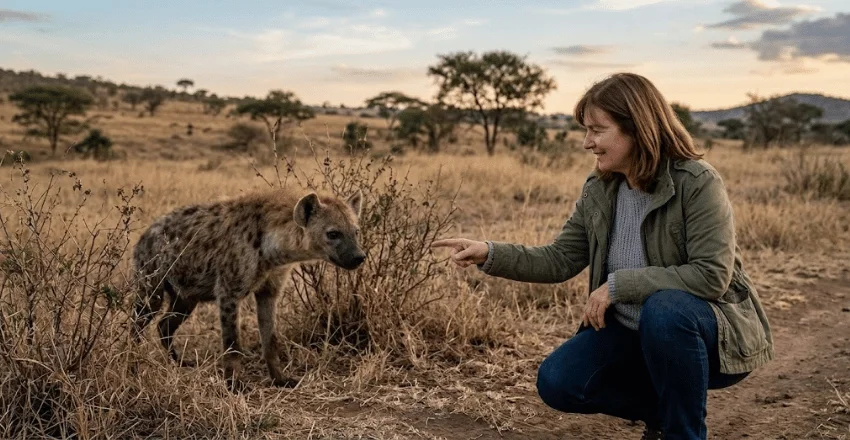
Natural selection can produce similar body shapes in unrelated groups. Biologists call this pattern convergent evolution. It happens when similar lifestyles favor similar useful traits.
These carnivores evolved long muzzles, sturdy limbs, and bodies suited for covering ground. At a glance, those features can resemble canids. Their ancestry still places them firmly among feliform carnivorans. Look-alike pairs turn up often in nature, and Writinge’s pet and animal explainers cover several more of them.
Hyaenids, Dogs, and Cats Compared
The clearest comparison starts with taxonomy, not appearance. Family membership tells you which evolutionary branch each animal belongs to. Surface traits can mislead because unrelated species sometimes adapt in similar ways.
| Feature | Hyaenids | Dogs | Cats |
|---|---|---|---|
| Family | Hyaenidae | Canidae | Felidae |
| Carnivora branch | Feliformia | Caniformia | Feliformia |
| Common examples | Spotted, striped, brown, aardwolf | Domestic dogs, wolves, foxes | Domestic cats, lions, tigers |
| True canine? | No | Yes | No |
| True feline? | No | No | Yes |
The table shows why the simple dog-versus-cat choice is misleading. Hyaenids share the feliform branch with cats but did not become felids. Dogs occupy the separate caniform branch.
The Four Living Species in Hyaenidae
Hyaenidae contains four living species. Three are familiar bone-cracking forms, while the aardwolf follows a different feeding strategy. This variety makes the family more diverse than its reputation suggests.
- Spotted hyena: Crocuta crocuta, the family’s largest living member.
- Striped hyena: Hyaena hyaena, recognized by its striped coat.
- Brown hyena: Parahyaena brunnea, a shaggy species of southern Africa.
- Aardwolf: Proteles cristata, a small relative that feeds mainly on termites.
The spotted species is the familiar “laughing” animal from many documentaries. The striped and brown species differ in range, coat, and ecology. The aardwolf stands apart because insects dominate its diet.
Are Hyaenids More Closely Related to Cats Than Dogs?
Yes, but “closer to cats” needs one important caveat. Hyaenids are not members of Felidae, the family containing true cats. They share the broader feliform branch with cats and several other carnivore families.
Think of the relationship as neighboring branches, not one family. Hyaenidae and Felidae separated deep in carnivore evolution. Calling a hyena a cat is therefore as inaccurate as calling it a dog.
Can Hyaenids Breed With Dogs or Cats?
They cannot produce normal hybrids with domestic dogs or cats. These animals belong to different families with long-separated evolutionary histories. Similar body shapes do not create reproductive compatibility.
Reliable science does not support claims of hyena-dog hybrids. Dogs can hybridize with some close canid relatives, but Hyaenidae lies outside Canidae. That evolutionary gap is far larger than differences among dog breeds.
African Wild Dogs and Hyaenids Are Different Animals
An African wild dog is a true canid, even though it shares habitat with spotted hyaenids. Its family is Canidae, which also contains domestic dogs and wolves. A hyena belongs to Hyaenidae instead.
Both groups can hunt socially and move across open habitats. That ecological overlap helps explain some superficial similarities. Their family trees still split at the feliform-caniform division.
Being Cat-Like Does Not Mean Being a Cat
Feliform means cat-like. The label does not mean cat. Taxonomic names describe broad evolutionary groupings.
A mongoose is also a feliform, yet nobody calls it a cat. The same logic applies to hyaenids. They are best described as Hyaenidae within the cat-like branch of Carnivora.
Hyaenids Are Hunters, Not Only Scavengers
Classification is not the only common source of confusion. Spotted hyenas are capable hunters as well as opportunistic scavengers. San Diego Zoo describes the spotted species as a strong, capable hunter.
That matters because body shape reflects lifestyle as well as ancestry. Endurance movement, social hunting, and competition can favor traits that resemble canids. Those similarities still do not change the underlying taxonomy.
Frequently Asked Questions
Are hyenas dogs or cats?
They are neither dogs nor true cats. They belong to the separate family Hyaenidae. Their family sits in Feliformia, making them closer to cats than dogs.
What family are hyenas in?
They belong to the family Hyaenidae. That family contains three bone-cracking species and the aardwolf. Hyaenidae sits inside the cat-like suborder Feliformia.
Why do hyenas look like dogs?
Similar environmental pressures favored several dog-like traits. Long muzzles and running-adapted bodies can make them appear canine. This resemblance reflects convergent evolution rather than close dog ancestry.
Is an aardwolf a hyena?
Yes, the aardwolf belongs to Hyaenidae. It differs strongly from its larger relatives because it mainly eats termites. Its diet does not remove it from the family.
Can a hyena mate with a dog?
No confirmed hyena-dog hybrids exist. The two animals belong to separate carnivore families and distant evolutionary branches. Their dog-like resemblance does not make them genetically compatible.
Are hyaenids closer to cats or mongooses?
They belong to the same broad feliform group as both. Modern research places their nearest relationships among other feliform families, including mongooses and related carnivorans. “Closer to cats than dogs” remains a useful simplified answer.
The Bottom Line
The best short answer is simple: hyaenids are not dogs or cats. They belong on the feliform side of Carnivora. Their canine look developed because similar lifestyles can shape unrelated animals in similar ways.
Cat owners who want a gentler approach can also read our guide to how to discipline a cat. The Writinge homepage collects newer explainers across several categories.