
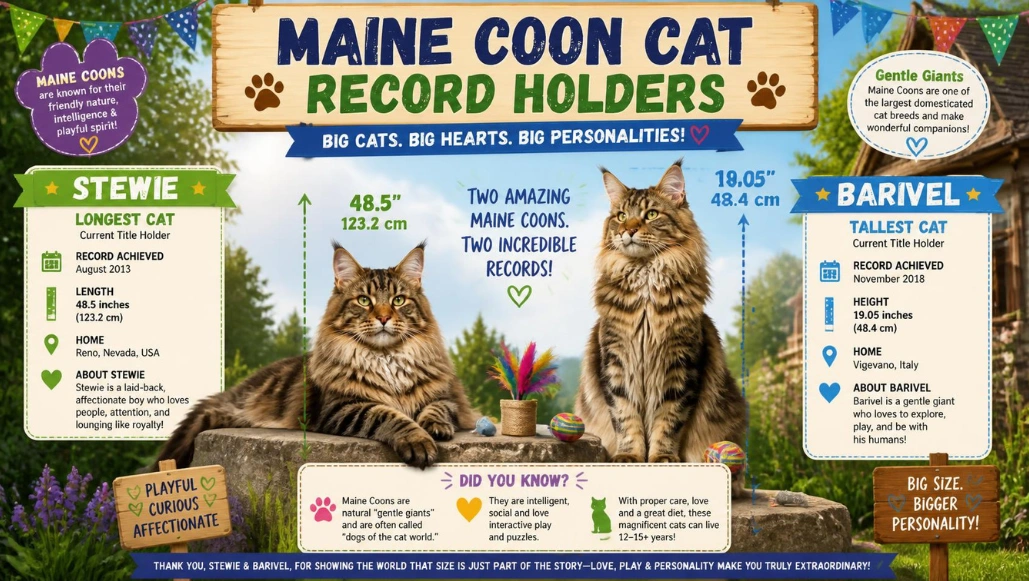
The world record for the largest Maine Coon cat has two answers, depending on the category. Stewie remains the longest domestic cat ever measured by Guinness World Records. Barivel, measured in Italy in 2018, is the cat Guinness published as the longest living domestic cat.
Short answer: Stewie holds the record, a Nevada Maine Coon measured at 48.5 inches in 2010. Barivel of Italy was verified at 47.2 inches in 2018 for Guinness’s living-cat record. So “largest” depends on whether you mean ever or living.
| Record | Cat | Verified size | Place | Status |
| Longest domestic cat ever | Stewie | 48.5 in / 123 cm | Reno, Nevada, USA | All-time Guinness record |
| Longest living domestic cat | Barivel | 47.2 in / 120 cm | Vigevano, Italy | Guinness living-cat record, verified 2018 |
| Former longest-living cat | Ludo | 46.6 in / 118.33 cm | Wakefield, United Kingdom | Former record holder |
Key Takeaways
- Stewie still holds the all-time Guinness record at 48.5 inches from nose to tail.
- Barivel was verified at 47.2 inches in 2018 for the longest living domestic cat title.
- Guinness now focuses on length and height records rather than domestic-animal weight records.
- Record holders are extreme outliers and should not define a healthy target size for a pet.
- For more cat topics, browse Writinge’s pet guides.
World Record Largest Maine Coon Cat: Two Records to Know
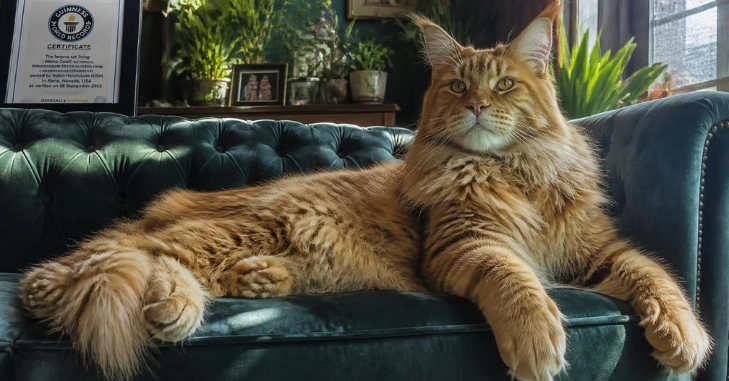
Search results often blur “largest,” “longest,” and “heaviest” into one label. The World Record Largest Maine Coon Cat distinction is important because Guinness separates these ideas into specific record categories. That distinction explains why Stewie and Barivel can both appear as record holders.
Stewie holds the all-time length record, which Guinness still lists. Barivel took the living-cat title after his 2018 measurement. The measurements differ by about 1.3 inches, with Stewie remaining longer.
Stewie: the longest domestic cat ever
Mymains Stewart Gilligan, better known as Stewie, lived in Reno, Nevada. Guinness measured him at 123 centimeters, or 48.5 inches, on August 28, 2010. His record page still identifies him as the longest domestic cat ever.
Stewie was also a certified therapy animal and visited a local senior center. He died in January 2013 after battling cancer. His record survived him and remains an extraordinary benchmark for domestic-cat length.
Barivel: the longest-living domestic cat
Guinness lists Barivel in Vigevano, Pavia, Italy, with owner Cinzia Tinnirello. It verified his length at 120 centimeters, or 47.2 inches, on May 22, 2018. Guinness published him as the longest living domestic cat after that verification, and a living-cat title can pass to another animal over time.
Barivel was only about two years old when Guinness verified the measurement. That mattered because this breed matures more slowly than many domestic cats. His record continued a long run of length titles held by exceptionally large cats from this breed.
Why “Largest” Does Not Mean “Heaviest”
Guinness no longer uses body weight for domestic-animal size records. Its historical coverage explains that it now focuses on length and height. Current cat records therefore use defined physical measurements rather than body weight.
This rule prevents a heavy pet from becoming record-worthy simply because of excess body fat. It also makes record claims easier to compare using a defined physical measurement. Viral “heaviest cat” claims usually circulate without independent verification, so they are not equivalent to a ratified Guinness length record.
How Big Do These Cats Normally Get?
The International Cat Association classifies the Maine Coon as one of the largest cat breeds. TICA lists healthy adult males around 18 to 22 pounds. Its overview places adult females around 12 to 15 pounds.
TICA also says full size can take three to five years. The breed standard favors a long, muscular, rectangular body with substantial bone. Balance and proportion matter more than chasing an extreme number on a scale.
Why This Breed Produces So Many Length Records
The breed developed as a sturdy working cat in the northeastern United States. Its standard calls for a long body, broad chest, substantial structure, and long tail. Those traits naturally support impressive nose-to-tail measurements.
Slow maturation also gives these cats more time to develop their adult frame. Genetics still creates wide differences among individuals from the same breed. A record holder represents an extreme exception, not a normal growth target.
Stewie, Barivel, and Ludo Compared
Three names appear repeatedly because each held a major Guinness length title. Their verified measurements are clearer than social-media photos or unverified weight claims. The table below separates the record categories and measurement dates.
| Cat | Length | Verified | Record significance |
| Stewie | 48.5 in / 123 cm | 2010 | Longest domestic cat ever |
| Barivel | 47.2 in / 120 cm | 2018 | Longest living domestic cat |
| Ludo | 46.6 in / 118.33 cm | 2015 | Former longest-living domestic cat |
Ludo held the living record before Barivel surpassed him by about 1.7 centimeters. None of these measurements changed Stewie’s separate all-time category. This difference is the detail many quick summaries miss.
Does a Bigger Cat Mean a Healthier Cat?
No healthy cat needs to approach a world record. Body condition, mobility, muscle, and veterinary guidance matter more than maximum weight. Owners should not overfeed a growing cat to encourage a larger frame.
Extra size can also affect everyday equipment and movement around the home. Choose sturdy scratchers, wide litter boxes, supportive beds, and carriers that fit comfortably. Writinge’s home improvement guides can help with broader pet-friendly planning.
What Owners Should Learn From the Record Holders
The useful lesson is not to chase a record. These cats show how much natural variation can exist within one large breed. Healthy growth should follow genetics, balanced nutrition, exercise, and routine veterinary care.
Large cats still need the same behavioral outlets as smaller pets. They need scratching, climbing, play, rest, and predictable routines. Writinge’s humane cat training guide explains how redirection and rewards can shape household behavior.
The Bottom Line
Stewie remains the longest domestic cat ever recorded by Guinness at 48.5 inches. Barivel was verified at 47.2 inches in 2018 for the living-cat record. Both records show why this American breed has such a strong reputation for size.
Use those numbers as fascinating history, not as a growth goal for your pet. Healthy condition and comfortable movement should matter more than extraordinary measurements. Keep exploring Writinge’s pet coverage for practical cat care and behavior guidance.
Frequently Asked Questions
What is the world record largest Maine Coon cat?
Stewie holds the all-time Guinness record for domestic-cat length at 48.5 inches. They measured him in Reno, Nevada, in August 2010. Barivel holds the separate living-cat record at 47.2 inches.
Is Barivel bigger than Stewie?
No, Stewie’s verified length was 123 centimeters, while Barivel measured 120 centimeters. Barivel is about three centimeters shorter. His title applies to the longest-living domestic cat category.
How big does a typical Maine Coon get?
TICA lists healthy adult males around 18 to 22 pounds. Adult females are commonly listed around 12 to 15 pounds. Individual size varies, and mature proportions matter more than a single weight target.
Why does Guinness use length instead of weight?
Guinness says it stopped recognizing domestic-animal records based on weight. The change avoids rewarding potentially unhealthy weight gain in pets. Modern size records instead use measures such as length or height.
Has Stewie’s record been beaten?
No later domestic cat has been credited with passing his 123-centimeter measurement from 2010. Guinness has continued to cite that figure for the longest domestic cat ever. Record listings do change, so check the Guinness record page for the current entry.