

The homestead meaning in American English usually refers to a home together with the land around it, especially property where a family lives. The word also has important legal and historical meanings in the United States. Today, people may also connect it with a self-sufficient lifestyle that includes gardening, food preservation, raising animals, or producing more at home.
A homestead is generally a family home together with its surrounding land and related buildings. In U.S. law, the term may describe a primary residence that receives certain protections under state law. Historically, it also refers to land claimed under federal settlement laws such as the 1862 Homestead Act.
| Meaning or use | What it refers to |
| Everyday U.S. use | A family home, surrounding land, and sometimes outbuildings |
| Legal use | A primary residence that may qualify for protections or exemptions under state law |
| Historical use | Public land claimed and settled under U.S. homesteading laws |
| Modern lifestyle use | Living with greater household self-sufficiency through gardening, food production, repairs, or similar practices |
| Part of speech | Most often a noun; “to homestead” can also be used as a verb. |
Key Takeaways
- The simplest definition is a home together with the land around it.
- The word does not automatically mean a working commercial farm.
- In property law, its exact legal effect depends on state rules and the type of debt or exemption involved.
- The term has a major connection to the Homestead Act of 1862 and U.S. westward settlement.
- Modern homesteading often describes a lifestyle rather than a special form of land ownership.
Homestead Meaning in Everyday American English
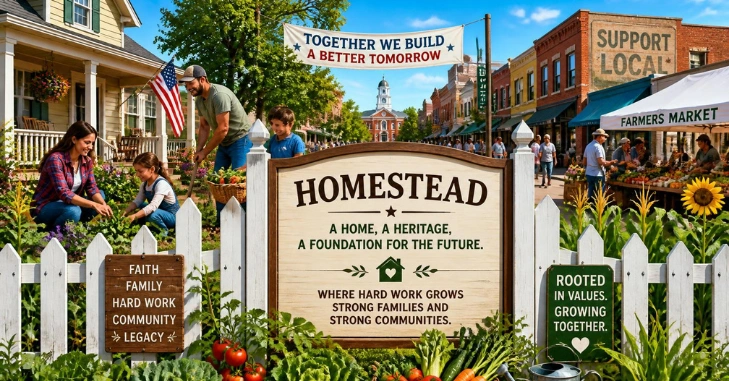
The homestead meaning is most often connected with a dwelling and the land surrounding it. Cambridge Dictionary gives a similar U.S. definition, describing a house and its surrounding land, often associated with farming. The idea is broader than the house itself because it can include yards, fields, barns, sheds, and other parts of the property.
The word comes from Old English roots connected with “home” and “stead,” or a place where someone lives. Its history helps explain why the word feels more permanent than a simple reference to a house. In modern American speech, it can suggest a family property with a strong connection to place, land, or long-term residence.
Four Main Ways Americans Use the Word
Context matters because the same word can point to several related ideas. A sentence about a family property usually carries a different meaning from one about bankruptcy law or nineteenth-century settlement. These four uses explain most situations in which American readers are likely to encounter the term.
1. An Everyday Home and Its Land
Calling a property a homestead often emphasizes both the residence and the ground surrounding it. A rural house with a garden, workshop, barn, or acreage is an obvious example, although the word does not require every one of those features. Families may also use it emotionally to describe property that has remained in the family for generations.
This meaning overlaps with words such as “home,” “farmstead,” “property,” and “family residence.” The emphasis normally falls on the place as a settled home rather than on its market value. That distinction explains why the word can carry a stronger sense of roots and permanence than “house.”
2. A Legal Term for a Primary Residence
In U.S. legal writing, “homestead” can refer to a principal residence that receives certain protections under applicable law. Those protections may concern creditor claims, forced sales, property taxes, or other issues, but the details differ considerably among states. Nolo’s legal definition, for example, connects the term with a family residence and property that may receive protection from particular creditor claims.
A legal designation should not be treated as a universal shield against every debt or claim. State statutes, constitutional provisions, ownership structure, and the kind of debt involved can change the result. Readers researching a specific property issue can also browse Writinge’s Law section for related U.S. legal topics.
3. A Historical U.S. Land Claim
The Homestead Act of 1862 gave eligible settlers a route to claim surveyed federal land by meeting requirements that included residence and improvement. The National Archives record of the Homestead Act states that qualified claimants could obtain 160 acres after living on and improving the property for five years, subject to the law’s conditions. President Abraham Lincoln signed the act on May 20, 1862.
The National Park Service history of the homesteading law reports that about 270 million acres, roughly 10 percent of the United States, were eventually transferred under federal homesteading laws. That expansion also affected lands long inhabited by Indigenous peoples, so the history involves more than the familiar image of settlers receiving “free land.” The main federal program ended in 1976, with special provisions continuing in Alaska until 1986.
4. A Modern Self-Sufficient Lifestyle
Modern homesteading usually describes efforts to produce more of what a household needs at home. People may grow vegetables, preserve food, keep permitted backyard animals, repair household items, collect rainwater where lawful, or reduce dependence on purchased services. A large rural property can support these activities, but acreage is not the defining feature.
Someone living in a suburb may practice several of the same habits on a much smaller lot. The modern lifestyle use therefore differs from the old federal land program and from a formal property-law classification. Readers interested in practical home projects can explore Writinge’s Home Improvement section for related ideas.
How It Differs From a Farm, House, and Ranch
These words overlap, but they are not interchangeable. The easiest way to separate them is to ask whether the speaker is emphasizing residence, agriculture, or the scale and purpose of the land. A single property may fit more than one category at the same time.
| Term | Main emphasis | Must be agricultural? | Usually a residence? |
| Homestead | Home plus associated land | No | Yes. |
| House | The residential building | No | Yes. |
| Farm | Agricultural production | Usually | Not always |
| Ranch | Land used mainly for livestock or grazing | Usually | Often, but not required |
| Farmstead | Farmhouse and nearby farm buildings | Yes. | Usually |
A homestead may contain a productive garden, chickens, or several acres without operating as a commercial farm. A farm, by contrast, is defined more by agricultural production than by the owner’s emotional or legal connection to the residence. This is why a suburban property can fit the modern lifestyle sense even when no one would reasonably call it a farm.
The difference also matters when researching property rights. Everyday vocabulary cannot tell you how a deed, lien, tax rule, or exemption applies to a specific parcel. Writinge’s Real Estate section is a useful starting point for related ownership and property topics.
What Does Homesteading Mean Today?
For many Americans, homesteading now means increasing household independence rather than obtaining government land. A person might start with a vegetable garden, learn to preserve seasonal produce, compost food waste, or handle routine repairs. Someone with more space might add fruit trees, beehives, poultry, or other activities permitted by local rules.
There is no fixed acreage that turns this lifestyle on or off. Local zoning, homeowners association rules, water regulations, animal ordinances, climate, budget, and available time often matter more than lot size. Even outdoor design can support food growing or practical use, and Writinge’s outdoor-space design ideas offer examples of making residential land more functional.
The modern movement also should not be confused with complete self-sufficiency. Most households still depend on utilities, stores, medical care, transportation, and professional services. The goal is often greater practical independence in selected parts of daily life rather than complete separation from the wider economy.
Why the Legal Definition Deserves Extra Care
A dictionary definition can explain the word, but it cannot determine whether a particular home qualifies for a state exemption. U.S. states set different eligibility rules, value limits, filing procedures, and exceptions. Certain debts or federal claims may also receive different treatment from ordinary creditor claims.
Property ownership questions can become more complicated after marriage, divorce, inheritance, refinancing, or a title transfer. A change in the deed does not necessarily create the legal protection a homeowner expects. Writinge’s quitclaim deed guide explains why title transfers and other property obligations need to be considered separately.
For that reason, a homeowner should check the rules of the state where the property is located before making a legal or financial decision. County tax offices, state statutes, courts, and qualified local professionals can provide information tied to a specific jurisdiction. A general word definition is useful for understanding a document, but it is not a substitute for legal advice about an individual case.
Examples in Sentences
The sentences below show the word at work in each of its common senses.
- Her grandparents built the family homestead near the edge of town.
- The couple wanted enough land for a garden, workshop, and small homestead.
- The lawyer reviewed whether the property qualified as a homestead under state law.
- After moving to the country, Maya began growing vegetables and preserving food at home.
- The history class studied how federal land policies changed settlement across the American West.
These examples show why surrounding words matter. Family history suggests the everyday sense, while lawyers and exemptions signal a property-law meaning. Gardening, preserving food, and household production usually point toward the modern lifestyle sense.
Conclusion
The homestead meaning can change depending on the context, but its central idea is a home and the land connected to it. In everyday American English, a homestead may describe a family residence, surrounding property, and related buildings. It can also describe a lifestyle focused on gardening, food preservation, raising animals, household production, and greater self-reliance.
Frequently Asked Questions
What is the homestead meaning in simple terms?
In simple terms, it means a home together with the land that belongs with it. The property may include a yard, fields, gardens, sheds, barns, or similar features. In U.S. legal and historical writing, the same word can carry more specialized definitions.
Is it the same as a farm?
No, the two ideas overlap but are not identical. A farm is mainly associated with agricultural production, while this term puts more emphasis on the property as a home. A family can grow food on residential land without operating a commercial farm.
Can a regular house qualify under property law?
A rural farm is not always required for a legal residence designation. Depending on state law, an ordinary primary residence may qualify for an exemption or protection even in an urban or suburban area. The requirements and amount of protection depend on the jurisdiction.
What was the Homestead Act?
It was a federal law signed in 1862 that allowed eligible claimants to obtain surveyed public land after meeting statutory requirements. Claimants generally had to occupy and improve the parcel before receiving title. The law had a major influence on U.S. settlement while also contributing to profound changes on lands inhabited by Native peoples.
Does homesteading still exist today?
The historic federal land-claim program no longer operates as it did in the nineteenth and twentieth centuries. People still use the verb to describe a lifestyle centered on household production, gardening, practical skills, and greater self-reliance. The meaning today is usually cultural or lifestyle-based rather than a promise of free federal land.