
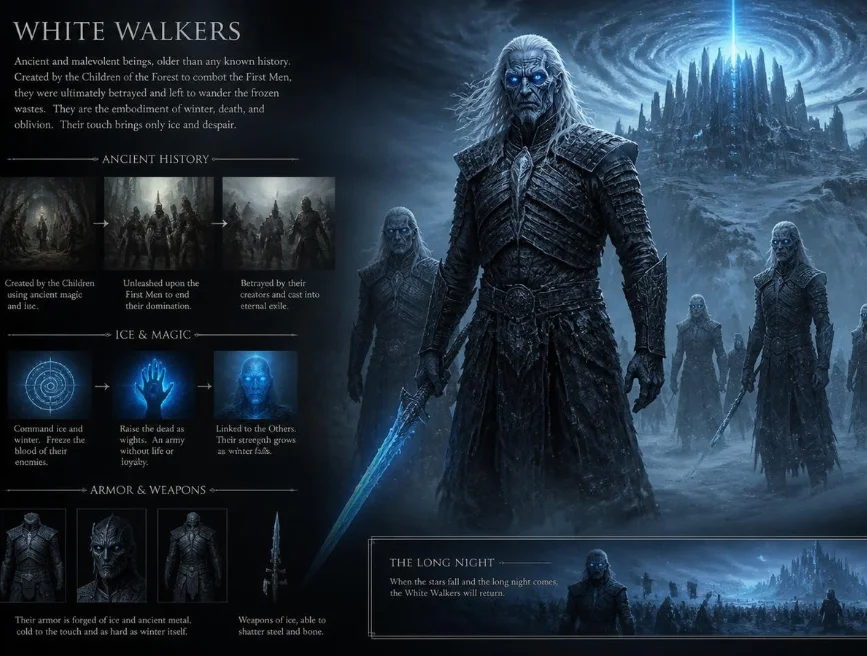
A White Walker is a supernatural ice creature from Game of Thrones and George R. R. Martin’s fantasy world. These beings come from beyond the Wall and command armies of reanimated corpses called wights. Their return creates a threat far larger than the political conflicts consuming Westeros.
The television series gives these creatures a clearer origin story than the published novels. HBO’s adaptation also introduces the Night King as their leader and connects him directly with their creation. The books remain more mysterious and usually call these beings “the Others.”
| Quick fact | Explanation |
|---|---|
| Fictional world | Westeros and the far North |
| Main TV series | Game of Thrones |
| Book name | The Others |
| TV leader | The Night King |
| Main servants | Wights |
| Known weaknesses | Dragonglass and Valyrian steel |
| Main territory | Beyond the Wall |
| Key ability | Raising dead humans and animals |
Direct answer: These beings are intelligent supernatural beings associated with ice, death, and the far North. They command wights rather than being wights themselves. In the HBO series, the Children of the Forest created their first leader as a weapon. Dragonglass and Valyrian steel can destroy them.
Key Takeaways
- Walkers and wights are different creatures.
- The television series gives them a defined creation story.
- The Night King exists as a specific character in HBO’s adaptation.
- Wights are corpses raised to serve the supernatural army.
- Dragonglass and Valyrian steel can kill the icy beings.
- The novels preserve much more uncertainty about their culture and goals.
- Their story represents a danger that Westeros repeatedly ignores.
What Is a White Walker in Game of Thrones?
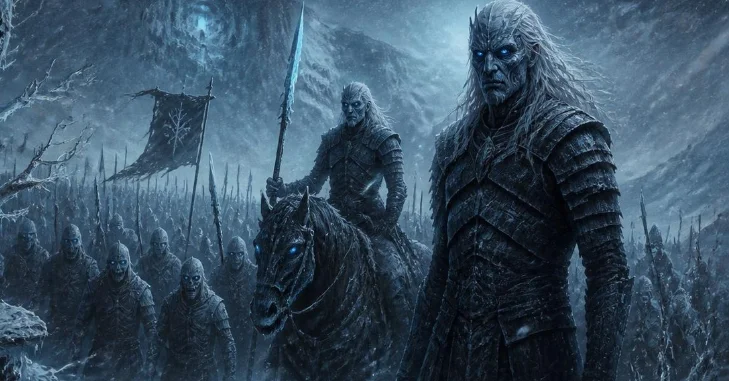
These White Walker lore creatures are ancient humanoid beings associated with extreme cold and supernatural power. They live beyond the Wall and eventually march south with an enormous dead army. Their glowing blue eyes make them among the show’s most recognizable supernatural enemies.
They are capable of thought, leadership, combat, and coordinated strategy. This separates them from the mindless corpses following their commands. That distinction becomes increasingly important as Jon Snow learns how the undead army works.
Readers exploring other fictional characters can also visit Writinge’s guide to Spider-Byte and her powers. That article similarly separates a character’s abilities from common misconceptions. Both stories show how adaptations can reshape characters for wider audiences.
Where Did the Walkers Come From?
The HBO series reveals their origin through Bran Stark’s visions. The Children of the Forest capture a human during their conflict with the First Men. They transform him by pushing dragonglass into his chest.
That man becomes the Night King in the television continuity. The Children created the weapon because they were losing territory to the First Men. Their attempt to protect themselves eventually produces a threat beyond their control.
The books do not provide this same confirmed creation scene. Martin’s Others remain older, stranger, and much less explained. That difference matters because viewers sometimes treat television answers as confirmed book lore.
Walkers vs. Wights: What Is the Difference?
The simplest distinction concerns intelligence and origin. Walkers are supernatural beings capable of independent action and command. Wights are dead humans or animals reanimated into servants.
A wight can look frighteningly similar because both display unmistakable signs of undeath. Yet the wight does not function as an independent commander. It belongs to the larger dead army controlled by supernatural masters.
This relationship creates an important tactical weakness during the television series. Killing a Walker can also destroy wights connected with that creature. Jon’s group witnesses this effect during its mission beyond the Wall.
| Feature | Walkers | Wights |
|---|---|---|
| Intelligent | Yes | Limited or no independent will |
| Alive before transformation | In TV lore, yes | Previously living corpse |
| Commands others | Yes | No |
| Blue eyes | Yes | Often |
| Dragonglass weakness | Yes | Different rules apply |
| Valyrian steel weakness | Yes | Not their defining weakness |
| Army role | Leaders | Soldiers |
What Powers Do They Have?
Their most dangerous ability is raising dead bodies into soldiers. The Night King demonstrates this dramatically after the massacre at Hardhome. Fallen humans can therefore strengthen the enemy instead of reducing its forces.
The creatures also possess strength and deadly weapons capable of challenging skilled human fighters. Their presence is strongly associated with intense cold and worsening weather. The series repeatedly uses falling temperatures as a warning of their approach.
The Night King possesses additional abilities not clearly shared by every member of his species. He can transform Craster’s sons and raise huge numbers of corpses simultaneously. He also kills Viserion before resurrecting the dragon for his own army.
Why Is the Night King Different?
The Night King is the central leader of the undead forces in HBO’s version. He was once human before the Children transformed him during the ancient conflict. His powers and importance exceed those of the other icy commanders.
His television role also creates one major difference between the books and show. George R. R. Martin’s published novels have not established an equivalent modern leader with the same identity. The legendary Night King from book history is a separate figure.
That distinction prevents a common misunderstanding about the franchise. Details established on television should not automatically be applied to the novels. The two versions increasingly follow different rules and histories.
How Can a White Walker Be Killed?
The television series establishes dragonglass and Valyrian steel as reliable weapons against these supernatural enemies. Samwell Tarly demonstrates that dragonglass can destroy one during an encounter beyond the Wall. Jon Snow later kills another using Longclaw, his Valyrian steel sword.
Ordinary weapons offer little security against such opponents. This makes rare Valyrian blades strategically important once Westeros recognizes the threat. Dragonglass becomes especially valuable because larger quantities can be obtained.
The difference between defeating a Walker and defeating a wight also matters. Fire is particularly useful against reanimated corpses in the book mythology. The supernatural commanders require different weapons and tactics.
Why Did the Army of the Dead Matter So Much?
The undead threat changes the scale of Game of Thrones. Kings and nobles spend years fighting for political control while a larger danger grows outside their borders. The Wall allows most southern leaders to treat that danger as distant folklore.
Jon Snow understands the problem because he encounters it directly. His priorities gradually move from political rivalry toward human survival. That shift puts him at odds with leaders focused on immediate power.
The conflict also gives the series one of its clearest recurring ideas. Political victory means little if nobody survives the coming war. The supernatural storyline turns “winter is coming” from a family warning into a literal survival threat.
For more television coverage, Writinge’s Entertainment section collects articles about shows, performers, and popular culture. Readers interested in television actors can also explore the profile of Joe Lo Truglio.
What Did the Spiral Symbols Mean?
The series repeatedly associates the undead with spiral-shaped arrangements. Similar patterns later appear in ancient carvings connected with the Children of the Forest. This visual connection suggests the Walkers borrowed imagery from their creators.
Showrunner David Benioff confirmed that the imagery originated with the Children. The repeated symbol therefore connects creator and creation instead of representing a separate invented language. Its precise philosophical meaning remains less clearly defined.
The ambiguity helped the symbol generate years of fan theories. Some interpretations went much further than the show’s confirmed explanation. Separating established information from speculation keeps the mythology easier to understand.
Books vs. TV: Why the Difference Matters
Martin’s novels call the supernatural species the Others far more often. They appear strange, elegant, dangerous, and connected with forces that remain unexplained. Their motives have not been reduced to one confirmed television-style mission.
HBO uses “White Walkers” as the standard name and gives audiences more concrete answers. The adaptation establishes the Night King, his creation, and his connection with the wider army. It also gives the conflict a decisive television ending.
Keeping these continuities separate prevents several common lore errors. A television explanation may never become the explanation used in Martin’s remaining novels. Future books could reveal motives or history that differ substantially from the adaptation.
Why They Remain Memorable: Game of Thrones Villains
The creatures work because they contrast with the human conflicts dominating Westeros. Political enemies negotiate, betray, marry, surrender, and change alliances. The army from the North represents something colder and less negotiable.
Their limited dialogue also keeps them mysterious for much of the series. Viewers understand their danger long before understanding their origins. That uncertainty makes early appearances especially effective.
Hardhome then changes their role from distant mythology into immediate catastrophe. The Night King’s ability to raise the newly dead shows why conventional warfare cannot solve the problem. Every battlefield can potentially create more soldiers for his side.
The Lasting Meaning of the Frozen Threat
The frozen army gave Game of Thrones a danger that existed beyond crowns and family rivalries. Its presence forced characters to decide whether survival mattered more than political ambition. That tension helped connect the fantasy storyline with the series’ human conflicts.
The mythology becomes clearer once the books and television series are separated. HBO provides answers about creation, leadership, wights, and weaknesses. Martin’s published story intentionally leaves far more uncertainty surrounding the Others.
For readers revisiting Westeros, that difference is part of the appeal. The television story has an ending, while the book mythology still holds unanswered questions. Those unanswered details leave room for future revelations about the ancient enemy beyond the Wall.
Frequently Asked Questions
Are White Walkers zombies?
No, they are not simply zombies. They are intelligent supernatural beings that command reanimated corpses called wights. The wights are much closer to the traditional idea of an undead zombie army.
Is the Night King one of the Walkers?
Yes, within the HBO television continuity, he is their leader and first known member. The Children of the Forest transformed him from a human thousands of years earlier. This origin belongs to the television adaptation rather than confirmed novel lore.
What kills the Walkers?
Dragonglass and Valyrian steel are the two established weapons used successfully against them. Sam uses dragonglass, while Jon destroys one with Longclaw at Hardhome. Ordinary steel does not provide the same protection.
Why do the Walkers have blue eyes?
The glowing blue eyes visually identify the supernatural transformation and undead forces. The show consistently uses them as a marker connecting Walkers, wights, and resurrected Viserion. It does not provide a detailed biological explanation for the color.
Are the Others and the Walkers the same?
They broadly represent the same supernatural race across the books and television adaptation. Martin’s novels primarily use the name “Others,” while HBO favors “White Walkers.” Their histories and specific characteristics differ between the two continuities.